
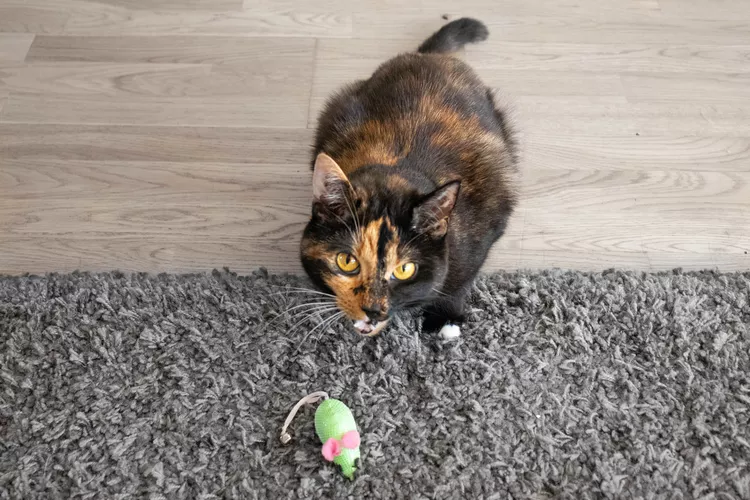
If you've ever received the "gift" of a dead lizard or mouse from your pet cat, you're not alone. Although it's been 10,000 years since cats were domesticated, their instinct to hunt remains strong. That's good news for people who own cats as a form of pest control, but not quite as pleasant when your furry indoor cuddle companion finds a pest somewhere in the house and brings it to the foot of your bed.
And while it might seem purely instinctual, the behavior is actually rooted in an interesting thought process. If you've ever wondered why cats leave "gifts" for their owners in the form of dead animals, keep reading to learn how it has to do with both their instinct to hunt prey and their desire to feed their loved ones. Plus, we've offered ways to help your cat curb the habit.
The Instinct to Hunt
Cats are born to hunt. Even if domesticated cats know they don’t need to catch their own food to survive, they cannot resist the urge and often enjoy the hunt and chase. Some cats that catch prey will bring their owners the dead animals—or, perhaps even more unpleasantly, sometimes ones that are still alive—to show off their prized catch for later consumption, as a teaching aid, or as a gift.
This prey-catching behavior has nothing to do with being hungry. Rather, the “prey” being caught by indoor cats often isn’t edible at all, but rather toy mice, balls, and garbage they felt that they “hunted.” These items may also be presented to you as gifts, even though they are inedible.
A Desire to Feed Their Families
Additionally, cats are pack animals, and they often want to share their bounty with their family. This is especially true of female cats who would normally teach their young how to hunt and eat. This means when a cat brings you an animal they caught, be it alive or dead, they consider you a part of their family. Their instincts are telling them this is what they need to do to survive and that they need to pass these important, life-saving skills onto their family.
How to Redirect the Prey Drive
Use Toys
The natural prey drive in a cat cannot be suppressed, but it can be redirected to playing rather than hunting. Rather than reinforcing prey drive by playing, the activity satisfies a cat's desire to hunt. Any toy that requires your cat to chase and catch an object is mentally stimulating its natural prey drive, including feather wands, laser pointers, moving toys, and other items that your cat simply cannot resist trying to catch.
A cat needs mental stimulation, especially if it is a cat that seems to have a strong prey drive. If it doesn’t have anything to hunt, chase, and catch, then it will find something to fulfill its prey drive. They might pounce on your feet as you walk by or climb up the curtains to catch imaginary prey.
Engage your kitty in plenty of playtime every day to redirect their natural hunting behaviors. This not only reduces behavioral problems for cats that are prone to bringing mice or lizards to your door, but it also provides exercise for the cat. Indoor cats are often overweight and can use a little help in shedding the pounds via movement.
Although many cats are satisfied with chasing a laser pointer, some need to simulate "killing" their prey, too. If your cat seems frustrated or continually seeks to destroy objects that it finds on the ground, such as a lone shoe, provide the cat with prey that it can "kill," such as a small stuffed animal.
Attach a Bell to Their Collar
Outdoor cats that hunt and kill native wildlife are so good at it that they are considered invasive species and detrimental to native populations of birds. Alert wildlife of an impending cat attack by attaching bells on a breakaway collar of an outdoor cat. This will spare the smaller critters, of course, but also ensure your cat can't as easily hunt.