
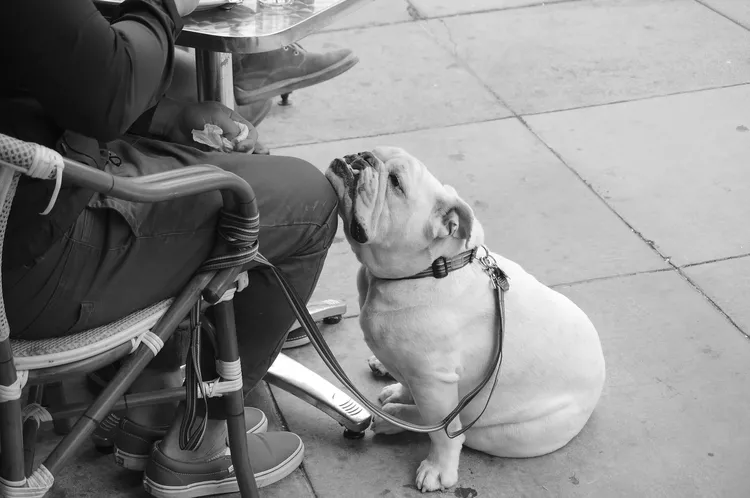
Is your dog a leaner? It might stand or sit by your legs and put much of its weight on you. Leaning is common in dogs, especially large and giant dog breeds. Many dogs that lean also like to lie with part of their body against yours. Is this common behavior normal, or is it a behavior problem?
Generally, leaning is usually a sign of affection or seeking comfort from their owner, not a behavior issue. It can also signal trust, as dogs feel safe being close to someone they rely on.
Why Dogs Lean on People
The answer is as simple. Dogs lean on people because they want to be close to them. By nature, dogs are social pack animals. Most dogs enjoy physical contact with humans. While smaller dogs can be picked up and cuddled, bigger dogs do what they can to get close. Some dogs are so affectionate it seems they are trying to somehow become a part of you! They lean in with all their weight. Some sit on your feet, sleep with their paws on you, and snuggle up on the couch or bed.
Some sources claim that leaning is a sign of dominance in dogs. However, dog behavior experts have proven that old canine dominance theories are incorrect. Dominance is not a personality trait. Rather it is a relationship between a pair of animals. It's unlikely your dog leans on you to assert any kind of dominance.
Some feel leaning is a way for dogs to try to take advantage of their humans. While dogs can figure out how to elicit certain responses in people, they are not manipulative. People show dogs (perhaps inadvertently) specific behaviors that result in certain responses. If you give your dog any kind of attention (good or bad) when it leans, it will lean on you whenever it wants attention.
In some cases, leaning can be a sign of fear or insecurity. Dogs cower or hide behind people when they are in fear, but that dog usually exhibits other signs of fear in addition to leaning. Dogs in need of confidence may be fearful or insecure. If you think this is the case with your dog, then it's best to ignore the leaning (don't encourage or discourage it). Use training to boost your dog's confidence.
Could Leaning Be a Problem?
Leaning is a harmless behavior in dogs. Leaning on people is not considered a behavior problem unless it really bothers you. If you really dislike it when your dog leans on you, simply walk away when it does this. Give it absolutely no attention until it stops leaning. Eventually, it will connect your actions with its behavior. If you need help with this and other training, consider hiring a dog trainer.
Some dogs try to be in physical contact with their humans as much as possible, even going so far as to follow their humans around the house. When this happens constantly, the behavior could be a sign of separation anxiety. Dogs with separation anxiety experience panic when you leave them alone. If a dog with separation anxiety anticipates you might be leaving the house soon, they will begin showing signs of anxiousness. Some dogs cannot bear to have you out of their sight. If you think your dog suffers from separation anxiety, talk to your veterinarian about your concerns. Your vet might refer you to an animal behaviorist for help. Your vet or veterinary behaviorist may also prescribe medication to help reduce your dog's anxiety, though this is ideally the last resort.